Slam, for Tennis Australia, 2020–2023
From clipboards to live scores for every member.
Slam is the social tennis club app, designed and developed for Tennis Australia: rosters, live umpiring, news and chat in one place. It's a Flutter app for iPhone, iPad and Android on Firebase, with live scoring and no scoring server. We took it from idea to design, build, both app stores and paid subscriptions.
- Client
- Slam, designed and developed for Tennis Australia
- Industry
- Sport & community clubs
- Services
- Mobile apps, real-time, payments, product design and launch
- Platforms
- Flutter for iPhone, iPad and Android; Firebase; Node.js on App Engine; Square
- Our role
- We designed, built, launched and marketed Slam, from the first sketch to App Store and Google Play subscriptions.
The challenge
Club volunteers juggled paper draws, score sheets, clipboards, printing and phone trees. Members and parents never knew who was playing when, or when a match was cancelled. The feature everyone wanted was live scoring: someone courtside taps the score on their phone, and everyone else in the club sees it change.
Live scoring sounds like a simple broadcast, one writer and many readers. In a club it isn't that tidy. Anyone with the app could pick up a match and start umpiring it, so two people might try at once. Phones lose signal at the far court, get locked, run flat or get handed to a child. Scores get corrected, and a wrong tap followed by a fix mustn't leave the ladder points wrong. Spectators need to see changes without refreshing, on cheap phones on club Wi-Fi.
And it was one product on a small budget. Every server we ran was a server to patch, monitor and pay for.
Our approach
- Use the platform's primitives before writing servers. The Firebase Realtime Database already offers listeners, transactions, disconnect handlers and triggers. Together they replaced a socket server and a session tracker.
- Avoid conflicts rather than resolve them. One umpire per match and score corrections as deltas meant no merge logic and no vector clocks.
- No admin website. Club administrators run everything from the same app their members use.
- Build the whole product. Design, engineering, store listings, marketing and subscriptions, because getting a volunteer to trust it on court is half the work.
What we built
Club management in the app
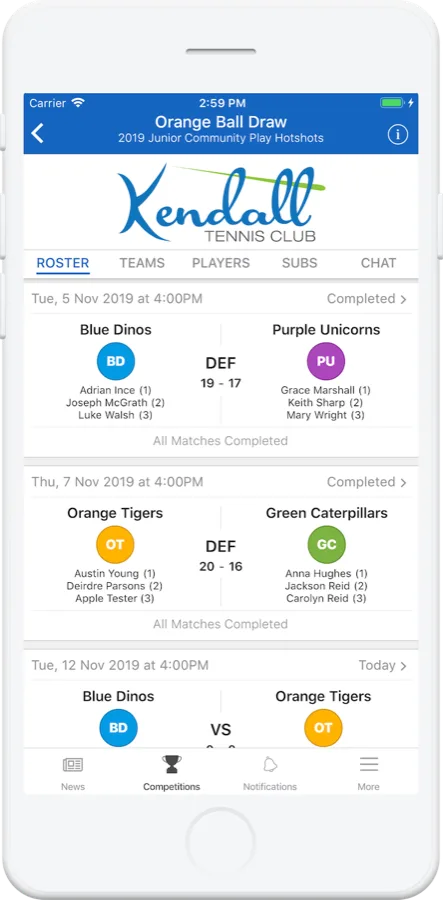
Competitions, teams, player registration and match formats are all set up in the app. Rosters are generated by a round-robin scheduler using the circle method, with byes for odd numbers of entrants, and stay customisable. Completing a set cascades to the roster item and on to finals.
Tap-to-umpire scoring
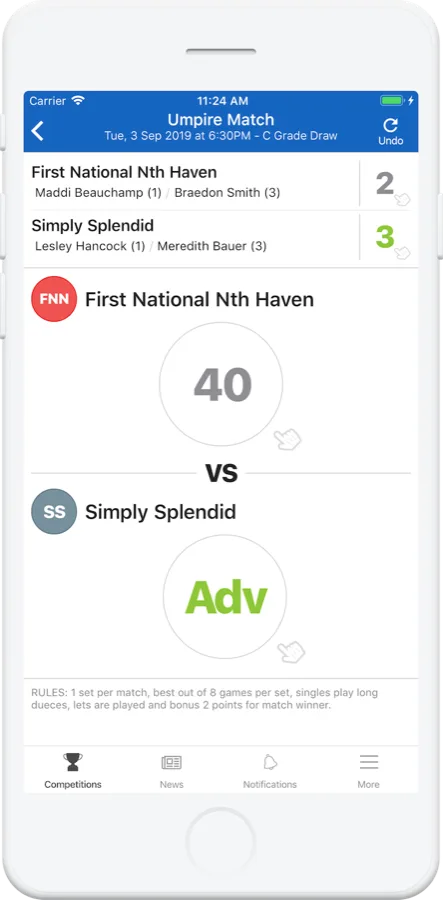
Even if you don't know the rules of tennis, you can tap the screen and the app keeps score. Scores are checked against each draw's rules, such as games per set, lead-by and limited games, with rule text people can read.
One umpire per match
Two people scoring one match isn't a merge problem; it's a question of who holds the pen. Each match carries a lock recording who holds it and when. Entering the umpire screen takes the lock if the match is free and playable, and anyone else is politely sent back. If the umpire's phone dies mid-set, a disconnect handler marks them offline and a Cloud Function releases their lock, but only if it's still theirs.
Live scores and safe corrections
Spectators subscribe to changes on the match, so scores update on every phone as each point is tapped. Score writes use transactions with a retry. Points are applied as the difference between the new and previous score, so a wrong tap and its fix cancel out exactly, even while other matches update the same player.
Club life
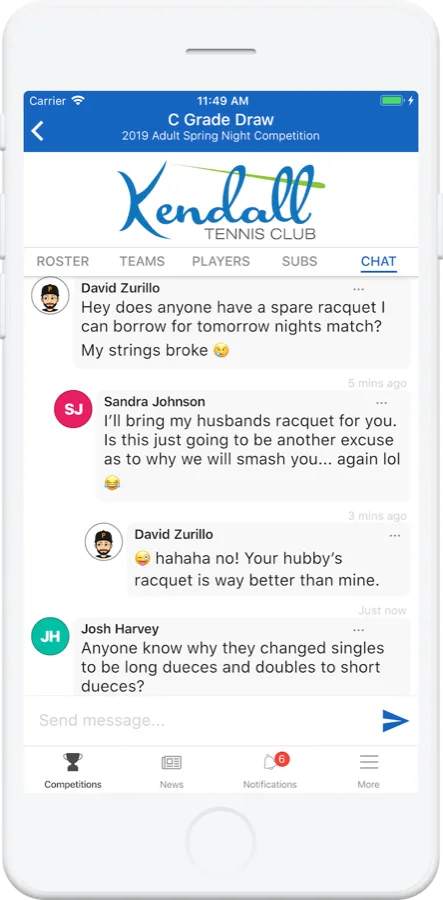
A news feed with likes and comments, draw chat rooms, messaging, photo albums and finding substitutes. Push notifications cover scores, cancellations, and when you or your children are scheduled to play. Clubs are invite-only and data is encrypted, with a profanity filter in chat.
Subscriptions and finding a club
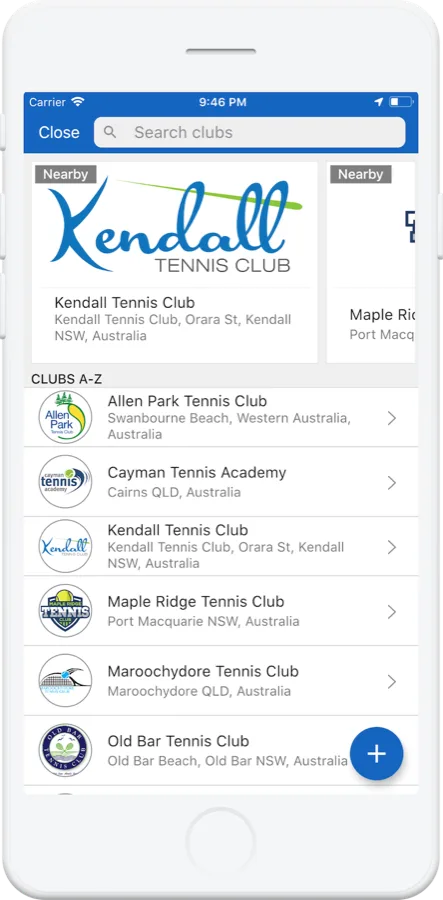
Club subscriptions are tiered by member count and paid through Square. A location search, using our own geohash encoder, finds nearby Australian tennis clubs. We also did the go-to-market: store listings, screenshots and preview videos, a club poster with store QR codes, onboarding screens and email templates.
The app
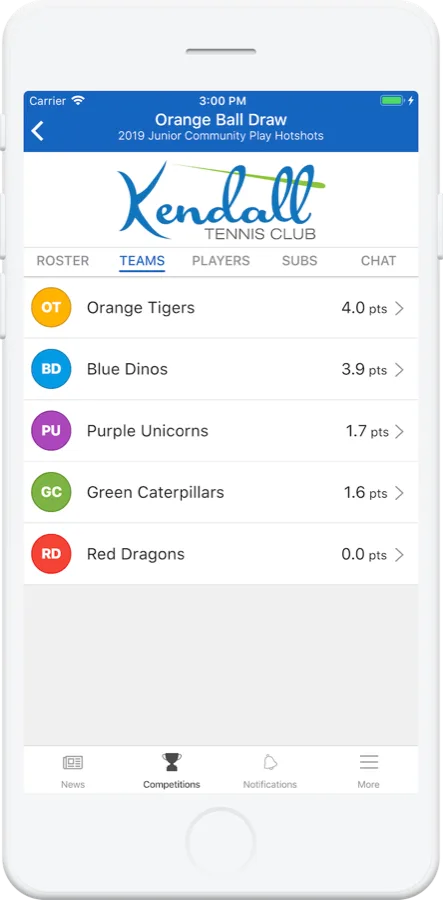
Screens from Slam on iPhone.
Architecture
Real-time without sockets.
- Umpire tapsScore written in a transaction
- Realtime DatabaseA per-club tree with short keys on hot paths
- SpectatorsChange listeners update every phone
- Cloud FunctionsPush notifications and lock release on disconnect
- App EngineSquare payments, email and match reminders
No scoring server to run: the database does the fan-out.
Results
- 1Flutter codebase for iPhone, iPad and Android
- 2app stores: App Store and Google Play
- Livescores for every member, as each point is tapped
- 0scoring servers to run
Under the hood
Real-time by default, with no admin website to maintain.
- Flutter
- Dart
- Firebase Auth
- Firebase Realtime Database
- Cloud Storage
- Cloud Messaging
- Cloud Functions
- Firebase Analytics
- Node.js
- Express
- App Engine
- SendGrid
- Square
- Geohash search
- Sketch
What it taught us
Plenty of business apps have the same shape as a tennis match: one person doing the work, many people watching, and phones that drop out at the worst moment. Job sites, inspections and dispatch boards all need someone clearly holding the pen and everyone else seeing it live. That's how we approach mobile and field apps and real-time data today.
The lock pattern carries into AI work too. On the Knowby platform, AI assistants can create guides through an MCP server, but only as private drafts, and a person decides when anything is published. Many readers, one explicit and revocable right to write.
What we'd do now
- Give every lock two ways out. Presence-based release covers a dropped phone; a time-based expiry covers everything else. Belt and braces cost one timestamp check.
- Test the rules before the screens. Scoring with three competition formats is pure logic, and pure logic deserves a thorough unit-test suite before any UI test is written.
- Keep the data tree shallow where it's hot. Deep per-club trees are easy to secure but costly to listen to. Flattening the live match data makes listeners cheaper and security rules clearer.
- Prefer managed primitives, then measure. Starting serverless was right for a club app on a small budget. The rule is to move a piece onto your own server only when a measurement says you must.
Questions
How does Slam show live scores without a scoring server?
The umpire's phone writes to the Firebase Realtime Database, and every phone watching that match receives the change through a listener. Cloud Functions handle push notifications.
What stops two people scoring the same match?
Each match has an umpire lock. The first person to open the umpire screen takes it, and anyone else is sent back while it's held.
What happens if the umpire's phone dies?
The database marks the user offline when the connection drops, and a Cloud Function releases their lock, as long as nobody else has taken over.
Which platforms does Slam run on?
iPhone, iPad and Android, from one Flutter codebase, published on the App Store and Google Play.
Related
The services behind this work, and more stories like it.
Services
Case studies

Essential Energy3,000+ paper forms and workflows removed. Field Portal put Essential Energy's crews on 3,500+ iPhones and iPads, and Apple told the story in iOS at Work.
KnowbyFilm a task, get the guide. Self-hosted generative AI and MCP on the Knowby platform we designed, architected and developed.
Our own studioDesign document to TestFlight in about a week. Zigland, an iOS game built with AI coding agents, with 1,202 automated tests.
Bring us the hard problem.
A 45-minute discovery call with the person who'll design and build it. Clear scope, regular showcases, honest advice, and no handovers to people you've never met.